Transparency Notice: All links to products on this page are direct links to major retailers including Amazon We do not receive any affiliate links and receive zero commission from any purchase you make. Our only goal is to get you pointed to the right product at the best available price. Recommendations are all based on complete independent research, expert reviews and real user feedback.
Living in a small apartment, rental, or RV is liberating in many ways – but laundry and dishes? Those two chores can make small space living feel like a punishment every day of the year. You’ve been there: lugging an overstuffed laundry bag down 3 flights of stairs to a coin-operated machine that smells like mildew, feeding in quarters to do a load of laundry that may or may not finish, or scrubbing dishes by hand for 30 minutes after a long day at work because your kitchen lacks a dishwasher hookup.
The good news? In 2026 you don’t have to live like that anymore.
- Why Go for Portable Appliances for Your Small Space?
- The Best Portable Washing Machines for Apartment Living
- Top Picks: The Best Portable Washer and Dryer Combos for Ultimate Convenience
- The Best Portable and Countertop Dishwashers to Save Time and Space
- How to Maintain Your Portable Appliances?
- Final Verdict: Which Upgrade Should You Make First?
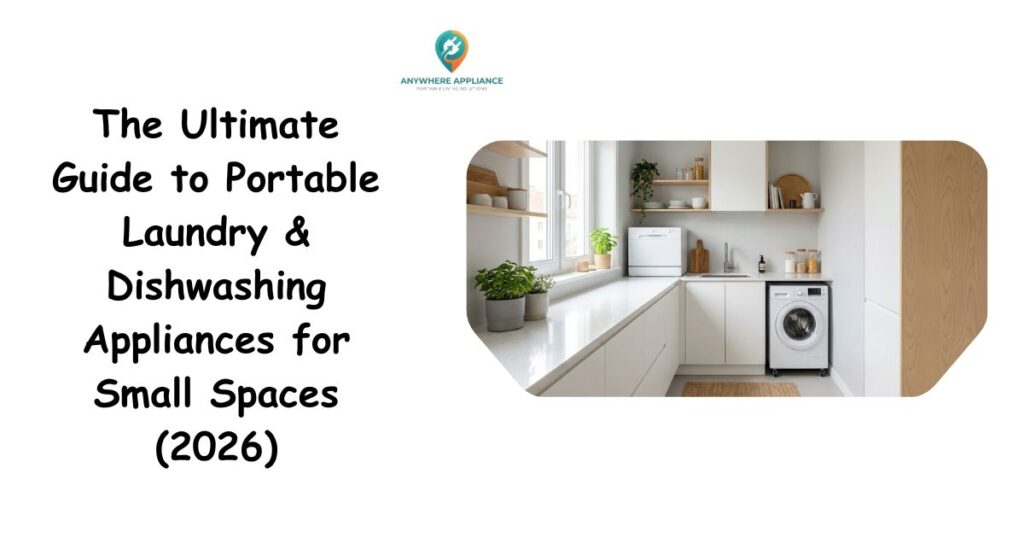
tucked neatly into a small apartment space — proof that limited
square footage doesn’t mean sacrificing clean clothes or dishes.
Portable and countertop appliances have gone from novelty gadgets to absolutely capable, well-engineered machines that deal with real household loads – without dedicated plumbing hookups, a contractor or a landlord’s blessing. This guide is your definitive, no-nonsense resource for understanding, comparing, and choosing the right portable washer, washer-dryer combo, or countertop dishwasher for your particular living situation.
Why Go for Portable Appliances for Your Small Space?
Before we dive into particular models, it’s worth understanding why portable appliances have become the go-to solution for millions of renters, tiny home dwellers, RV travellers and urban minimalists. The benefits extend far beyond the fact that it is compact.
No Permanent Plumbing Required
This is the one biggest advantage over full-sized machines. Traditional washers and dishwashers come with the need for dedicated hot/cold water lines and drain hookups – infrastructure that simply doesn’t exist in most apartments, studio units or older rental homes.
Portable appliances avoid it altogether in one of two ways:
Quick-connect sink adapters: A rubber adapter screws down on your existing faucet aerator in about 30 seconds. A supply hose is used to feed the machine directly with water. When you’re done, unplug and stow everything away. No tools, no drilling, no lease busters.
Built-in water tanks: Most countertop dishwashers coming out in 2026 have inbuilt 5 or 6 liter reservoirs. You fill the tank manually and push the start button and the machine does the rest. Zero plumbing contact required – ideal for kitchens with incompatible or pull out faucets
Space Flexibility That Full-Sized Machines Simply Can’t Match
Full-sized washers and dryers demand a dedicated laundry room or a utility closet with permanent hookups. Portable machines are designed to live wherever you need them — and disappear when you don’t.
| Feature | Portable Appliance | Full-Size Appliance |
|---|---|---|
| Average Width | 12–22 inches | 27–30 inches |
| Average Weight | 20–50 lbs | 150–200 lbs |
| Caster Wheels | Yes — rolls easily | No |
| Storage When Idle | Closet, under counter, behind a door | Permanent floor space required |
| Installation Required | None — plug and play | Plumber/electrician often needed |
| Renter-Friendly | 100% — zero modifications | Often requires landlord approval |
Cost and Energy Efficiency: The Numbers Make Sense
| Cost Factor | Laundromat (Per Month) | Portable Appliance |
|---|---|---|
| Average Monthly Spend | $40–$80 | $0 after purchase |
| Upfront Cost | $0 | $150–$500 (one-time) |
| Typical Payback Period | — | 3–8 months |
| Water Usage Per Load | 25–40 gallons | 5–15 gallons |
| Energy Per Load | High (industrial machines) | 30–50% less than full-size home units |
| Energy Star Eligible | No | Many 2026 models qualify |
Smaller drums and targeted wash cycles mean these machines genuinely sip water and electricity. At $150–$500 upfront, most portable appliances pay for themselves within a single year — often much faster.
The Best Portable Washing Machines for Apartment Living
The portable washers today will not work on a king-sized comforter, but the daily clothes, jeans, towels, bed sheets, and delicates, among others, will be washed with great power and softness. The 2026 generation is focused on motors with a lower noise level, quicker spin rate, and smarter drainage which is key to apartment life.
Top Portable Washing Machines for 2026
| Model | Capacity | Key Features | Best For | Approx. Price | Buy Link |
|---|---|---|---|---|---|
| BLACK+DECKER Small Portable Washer | 1.6 Cu. Ft. (~11 lbs) | 6 wash cycles, 850 RPM spin, quiet motor | Solo renters, studio apartments | ~$200 | Buy on Amazon |
| Magic Chef Compact Top Load Washer | 1.7 Cu. Ft. (~12 lbs) | 6 cycles including soak & spin, built-in wheels for mobility | Couples, moderate weekly loads | ~$220 | Buy on Amazon |
| Giantex Portable Mini Twin Tub | 17 lbs wash capacity | Separate wash/spin tubs, 1,300 RPM high-speed spin | Larger families in apartments | ~$160 | Buy on Amazon |
| Auertech Portable Semi-Automatic | 18 lbs wash capacity | High-capacity twin tub, rapid cycles for heavy daily use | Budget-conscious multi-person households | ~$140 | Buy on Amazon |
| COMFEE’ Portable Washing Machine | 1.6 Cu. Ft. (~11 lbs) | LED display, built-in rollers, 8 wash programs | Renters who want a premium user experience | ~$230 | Buy on Amazon |
What to Look for in a Portable Washer?
Pulsator vs. Agitator: Why This Matters More Than You Think
Virtually all portable washers available today have a pulsator and not the conventional central agitator. Here is the definite break down of what it means in regards to your clothes:
| Feature | Pulsator (Portable Standard) | Central Agitator (Traditional) |
|---|---|---|
| How It Works | Spins water from below in swirling currents | A tall central post physically twists and pulls clothes |
| Fabric Wear | Gentle — minimal friction and snagging | Harsher — can damage delicates over time |
| Usable Drum Space | More interior room | Center post reduces effective capacity |
| Energy Consumption | Lower | Higher |
| Best For | Everyday clothing, delicates, mixed loads | Heavy cotton and work wear |
For apartment use — where loads are typically smaller and fabric care matters — pulsators are the clear, practical winner.
Drainage Setup: Gravity Drain vs. Pump Drain
This is a detail many buyers overlook until they’re standing in their bathroom with a poorly draining hose. Knowing your setup before you buy prevents real headaches.
| Drainage Type | How It Works | Best Setup | Noise Level | Price Impact |
|---|---|---|---|---|
| Gravity Drain | Water exits via hose angled downward naturally | Machine elevated on shelf or placed near a tub | Silent | Reduces cost |
| Pump Drain | Built-in pump actively pushes water upward 4–5 feet | Ground-level setups draining into a sink | Slightly louder | Increases cost slightly |
Spin Speed Guide: What RPM Should You Target?
| Spin Speed (RPM) | Moisture Remaining After Spin | Estimated Air-Dry Time | Best For |
|---|---|---|---|
| Under 800 RPM | ~70–80% moisture remaining | 3–5 hours | Delicates, light fabrics |
| 800–1,000 RPM | ~50–60% moisture remaining | 1.5–3 hours | Everyday mixed loads |
| 1,000–1,300 RPM | ~30–40% moisture remaining | 45–90 minutes | Heavy cotton, towels, denim |
One of the most underestimated features of a portable washer is higher spin RPM. A 1,300 RPM machine will leave clothes almost as dry as a 800 RPM machine – indoor drying time reduced significantly in a small apartment where you just do not have the space to have five wet shirts hanging in the room more than half the day. For More Product You Can Check Here – The Best Portable Washing Machines for Apartment Living in 2026
Top Picks: The Best Portable Washer and Dryer Combos for Ultimate Convenience
Washer-dryer combos and twin-tub arrangements with separate spin dryers are the next logical step to the people who desire to do away with the air-drying step entirely. The 2026 market presents two main options, twin-tub machine and standalone compact dryers which would be combined with any portable washer.
Understanding the Two Main Combo Types
| Combo Type | How It Works | Best For | Price Range |
|---|---|---|---|
| Twin Tub | Single unit with separate wash basin and spin-dry basket | Budget buyers who want maximum moisture removal | $100–$200 |
| Fully Automatic Combo | One drum handles wash and dry cycle back-to-back | Set-and-forget convenience, minimal manual effort | $400–$1,200 |
| Portable Washer + Compact Dryer Pair | Two separate units used together | Flexibility to upgrade either unit independently | $300–$700 combined |
Leading Washer-Dryer Solutions in 2026
| Model | Type | Wash Capacity | Dry Capacity | Highlight | Approx. Price | Buy Link |
|---|---|---|---|---|---|---|
| Giantex Compact Twin Tub | Twin Tub | 11 lbs | 6.6 lbs spin | Best value balance of wash power and ~90% moisture removal | ~$160 | Buy on Amazon |
| Panda Compact Washer/Dryer | Twin Tub | 7.9 lbs | 5 lbs spin | Best-in-class spin basket, low vibration, quiet operation | ~$180 | Buy on Amazon |
| COMFEE’ Twin Tub | Twin Tub | 11 lbs | 6.6 lbs spin | LED display, 8 programs, integrated timer control | ~$200 | Buy on Amazon |
| Magic Chef 1.5 Cu. Ft. Compact Dryer | Standalone Dryer | — | 1.5 Cu. Ft. | Runs on standard 110V, pairs with any portable washer | ~$230 | Buy on Amazon |
| GE Portable Electric Dryer | Standalone Dryer | — | 3.6 Cu. Ft. | Multiple heat settings, stackable, 110V operation | ~$350 | Buy on Amazon |
How the Twin Tub Process Works Step by Step
Most first-time purchasers are surprised by the fact that the twin tub machines have only one short manual operation between washing and drying. The entire process is presented here in a clear manner that leaves no surprises:
| Step | Action | Time Required |
|---|---|---|
| 1 | Connect supply hose to faucet and fill wash tub | 2–3 minutes |
| 2 | Add detergent and clothing, set wash timer | 15–20 minutes wash cycle |
| 3 | Drain wash water via gravity drain hose | 2–3 minutes |
| 4 | Manually transfer wet clothes to spin basket | 1–2 minutes |
| 5 | Run spin cycle to remove 85–90% of moisture | 3–5 minutes |
| 6 | Hang clothes — already nearly dry and ready fast | — |
This is the one legal inconvenience of having two tubs that is in the presence of Step 4. It is a small price to pay to most users to have a machine costing $160 to almost all the moisture out and to do away with the visits to the laundromat completely.
Pros and Cons of Combo Units
| Factor | Pros | Cons |
|---|---|---|
| Time Savings | Wash + spin complete in under 35–40 minutes | Compact 110V dryers may run 1–2 hrs for full drying |
| Cost | Under $200 for most twin tubs | Fully automatic combos run $400–$1,200 |
| Convenience | Eliminates damp clothes hanging around your apartment | Twin tubs require manual clothes transfer between basins |
| Space | Single-unit footprint for twin tubs | Standalone dryer pairs require storage space for two units |
| Performance | ~90% moisture removal from spin cycle alone | Not ideal for large bulky items like comforters or duvets |
The Best Portable and Countertop Dishwashers to Save Time and Space
The best quality of life improvement that small-space dwellers may have is arguably countertop dishwashers. A process that involves 20-30 minutes of standing at the sink is cut down to loading, pushing one button and leaving the whole process. The 2026 generation is a step ahead, including in-built water tanks (creating no connection to the faucet at all), UV sanitization, automatic door drying, and sound levels so low that you will not even notice that the machine is on.
Hand-Washing vs. Countertop Dishwasher: The Real Comparison
| Factor | Hand Washing | Countertop Dishwasher |
|---|---|---|
| Active Time Per Load | 20–35 minutes | 1–3 minutes (load and press start) |
| Water Used Per Load | 9–27 gallons | 2–4 gallons |
| Max Water Temperature | ~110°F (tap hot) | Up to 167°F on sanitize cycle |
| Bacteria and Germ Removal | Moderate — depends on technique | High — hot water + detergent combination |
| Dishes Per Session | Unlimited (time permitting) | 2–6 place settings per run |
| Monthly Time Cost | 7–10+ hours | Under 30 minutes total active effort |
Best Countertop Dishwashers of 2026
| Model | Water Source | Capacity | Decibel Rating | Standout Feature | Approx. Price | Buy Link |
|---|---|---|---|---|---|---|
| Danby DDW631SDB | Faucet hookup | 6 place settings | 52 dB | Highest capacity in countertop class, stainless interior | ~$280 | Buy on Amazon |
| Hava Countertop Dishwasher | Tank or faucet (dual-mode) | 4–6 place settings | 60 dB | Flexible water source — works either way | ~$260 | Buy on Amazon |
| Midea MDC17P2DWW | 6L built-in tank | 2–3 place settings | 62 dB | Auto-open door at cycle end for faster, spot-free drying | ~$200 | Buy on Amazon |
| COMFEE’ Portable Mini | 5L built-in tank | 2–3 place settings | 62 dB | UV sanitization on top models, very compact footprint | ~$180 | Buy on Amazon |
| Hermitlux Countertop | 5L built-in tank | 2 place settings | 50 dB | Whisper-quiet — ideal for open-plan studio apartments | ~$170 | Buy on Amazon |
Built-in Tank vs. Faucet Connection: Which Is Right for You?
This is the single most important buying decision in the countertop dishwasher category. Get this wrong and you’ll end up with an incompatible machine.
| Factor | Built-in Tank (5–6L) | Faucet Connection |
|---|---|---|
| Installation Required | None — fill by hand and go | Quick-connect adapter on faucet aerator |
| Works With Any Faucet | Yes — completely independent | Standard threaded aerator faucets only |
| Works in RVs / While Traveling | Yes — fully portable anywhere | Limited — needs a compatible faucet |
| Loads Per Fill | 1–2 loads before manual refill needed | Unlimited — continuous water supply |
| Best Models | Midea, COMFEE’, Hermitlux | Danby DDW631SDB, Hava (dual-mode) |
| Ideal User | Solo dweller, RV life, modern apartment faucets | Couple or small family washing 6+ settings regularly |
| Price Range | $150–$260 | $250–$350 |
The secret: In case your kitchen has a pull-out spray-faucet or any other faucet with a modern threaded aerator (also extremely frequent in newer apartments), then use a tank model. Attempting to insert a quick-fit connector in a faucet that does not match is the major complaint of buyers of countertop dishwashers.
Drying Technologies: What the 2026 Models Actually Offer
The most frequent complaint of the countertop dishwashers is wet and spotty dishes. The problem is solved by the various technologies of the 2026 lineup in the following way:
| Drying Technology | How It Works | Result Quality | Models Using It |
|---|---|---|---|
| Residual Heat Drying | Leftover cycle heat passively evaporates moisture | Moderate — works on glass, poor on plastics | Basic entry-level models |
| High-Temp Air Drying | Dedicated heating element circulates hot air through drum | Good — faster and more even than residual | Most mid-range 2026 models |
| Auto-Open Door | Door pops open automatically at cycle end, releasing steam | Excellent — combines heat + fresh airflow | Midea MDC17P2DWW |
| Turbofan Drying | Internal fan actively moves hot dry air through the load | Very good — efficient and consistent | Select COMFEE’ models |
| UV Sanitization + Dry | UV light kills bacteria while heat simultaneously dries | Best available — dual hygiene and drying | Premium COMFEE’ models |
Noise Level Guide: What Those Decibels Actually Mean in a Small Space
This matters enormously when your kitchen is eight feet from your bed or your dining table.
| Noise Level | Decibels | Real-World Comparison | Suitable Environment |
|---|---|---|---|
| Ultra-Quiet | Under 50 dB | Library ambient noise level | Studio apartments, night-time use, light sleepers |
| Quiet | 50–55 dB | Soft conversation | Most apartments — barely noticeable during use |
| Moderate | 56–62 dB | Normal conversation volume | Open-plan spaces — audible but not disruptive |
| Loud | 65 dB and above | Busy restaurant background noise | Not recommended for small or open-plan spaces |
The quiet operation gold standard of Hermitlux at about 50 dB and the Danby at about 52 dB. Midea and COMFEE models at approximately 62 dB are still quite acceptable in the majority of apartments- approximately the same as someone conducting a comfortable conversation in the same room.
How to Maintain Your Portable Appliances?
It is true that a portable appliance that can last three years is not the same as an appliance that can last seven or more years as long as it is properly maintained. The particular demands of these machines in confined areas include mineral build-up and pet hair blockage in filters, mildew in the poor ventilated area of the machinery and the physical strain of rolling and repositioning.
For Portable Washers
| Maintenance Task | Frequency | How To Do It | Why It Matters |
|---|---|---|---|
| Clean lint / mesh filter | After every load | Remove filter, rinse under warm tap, replace | Prevents clogs, odors, and drainage slowdowns |
| Wipe down lid seals | After every use | Dry cloth along rubber gasket edges | Stops mildew forming in the seal folds |
| Run vinegar clean cycle | Monthly | 1 cup white vinegar in empty drum, full cycle | Dissolves mineral buildup and kills mildew spores |
| Inspect drain hose | Monthly | Check for kinks, cracks, or partial blockages | Prevents leaks and ensures complete drainage |
| Lubricate caster wheels | Every 6–12 months | Light machine oil on wheel axles | Keeps the unit rolling smoothly for storage and repositioning |
| Deep clean drum | Every 3 months | Baking soda + vinegar empty cycle | Removes detergent residue accumulation and odor |
Pet owner tip: If you regularly wash pet bedding or fur-covered clothing, run one empty rinse cycle immediately after to flush loose hair out of the drainage system before it accumulates into a slow-drain clog.
For Countertop Dishwashers
| Maintenance Task | Frequency | How To Do It | Why It Matters |
|---|---|---|---|
| Clear the food filter / trap | After every load with food residue | Remove bottom basket, rinse filter under hot tap | Prevents backups, bad odors, and redepositing food |
| Wipe door seal | Weekly | Damp cloth along the full door gasket | Prevents hidden mold growth in door creases |
| Descale the interior | Every 3 months (more in hard-water areas) | Run empty cycle with a citric acid packet or 1 cup white vinegar | Removes mineral scale that degrades heating efficiency |
| Clean spray arm holes | Monthly | Remove arm, rinse blocked holes under running water | Clogged holes reduce wash pressure and uneven coverage |
| Clean tank interior (tank models) | Every 2 weeks | Rinse with clean water, wipe with soft damp cloth | Prevents algae film and mineral residue inside reservoir |
| Test auto-open mechanism | Monthly | Run a cycle and observe whether door releases correctly | Ensures drying performance is working as intended |
Hard water tip: In case your tap water is hard run a descale after every 6-8 weeks instead of after 3 months. A packet of citric acid costing any kitchen supplies store is cheap and will greatly increase the life time of your heating element and spray arms – much cheaper than service call or premature replacement.
Final Verdict: Which Upgrade Should You Make First?
With strong options across all three appliance categories, the right decision comes down to what creates the most daily friction in your life right now. Here’s a quick decision guide:
| Your Situation | Best First Purchase | Recommended Model | Est. Price |
|---|---|---|---|
| Solo renter, mostly light weekly loads | Portable Washer | BLACK+DECKER 1.6 Cu. Ft. | ~$200 |
| Couple or 2-person household | Twin Tub Combo | Giantex or COMFEE’ Twin Tub | ~$160–$200 |
| Hate hand-washing dishes more than anything | Countertop Dishwasher (faucet) | Danby DDW631SDB | ~$280 |
| Kitchen faucet is pull-out or non-standard | Tank Countertop Dishwasher | Hermitlux or Midea MDC17P2DWW | ~$170–$200 |
| Want to eliminate both laundry trips and hand-washing | Washer + Dishwasher combo purchase | Giantex Twin Tub + Hermitlux Dishwasher | ~$330 total |
| Tight budget, maximum utility | Twin Tub Washer | Auertech Semi-Automatic | ~$140 |
| RV life or frequent mover | Tank Dishwasher + Compact Washer | COMFEE’ Mini Dishwasher + COMFEE’ Portable Washer | ~$380–$410 total |
| Want true set-and-forget laundry experience | Washer + Standalone Dryer pair | Magic Chef Washer + Magic Chef Compact Dryer | ~$450 total |
You May Also Like
The Bottom Line
No laundry and dishwasher products are compromised even in 2026, they are actually capable and can be used in an adaptable modern lifestyle. To the extent that one can spend $150500 on the correct equipment, toleration of coin-operated laundromat machines and hand-washing of every utensil are all optional.
The safest and most reliable first purchase by a majority of the solo renters is the BLACK+DECKER portable washer. In dishes, Danby DDW631SDB is the best option of counter top dishwasher to anyone who has a normal faucet and the Midea MDC17P2DWW is the intelligent one to any other person. The Giantex Twin Tub is the best bargain-to-performance product in case of laundry on a budget.
Your living space is small. You have no unlimited time and patience. The right portable gives both in your direction.